A joyful celebration of language and community
A blogpost written by Helen Myers
This Tamil Taster Session, led by Prabhu Rajendran and Mr Gnanamurugan (teacher and Tamil scholar), was an inspiring reminder of what London: City of Languages is all about — connection, curiosity, and the celebration of the languages that shape our city.
From the very first moment, it was clear that this session had been carefully and intelligently designed. A comfortable 40‑minute sequence allowed space for interaction, questions, and genuine engagement, without ever feeling rushed or overloaded.
A thoughtful, accessible introduction to Tamil
We began with a simple question: Who has heard Tamil spoken?
This immediately opened the room and set the tone for an inclusive, exploratory session.
Clear visuals helped us match sounds to familiar letters, giving us the sense that we were making real progress. As Mr Gnanmurugan explained – to my delight – breaking Tamil into syllables is an essential first step, especially as the language naturally “merges” sounds. This approach made the learning feel musical, logical, and wonderfully accessible.
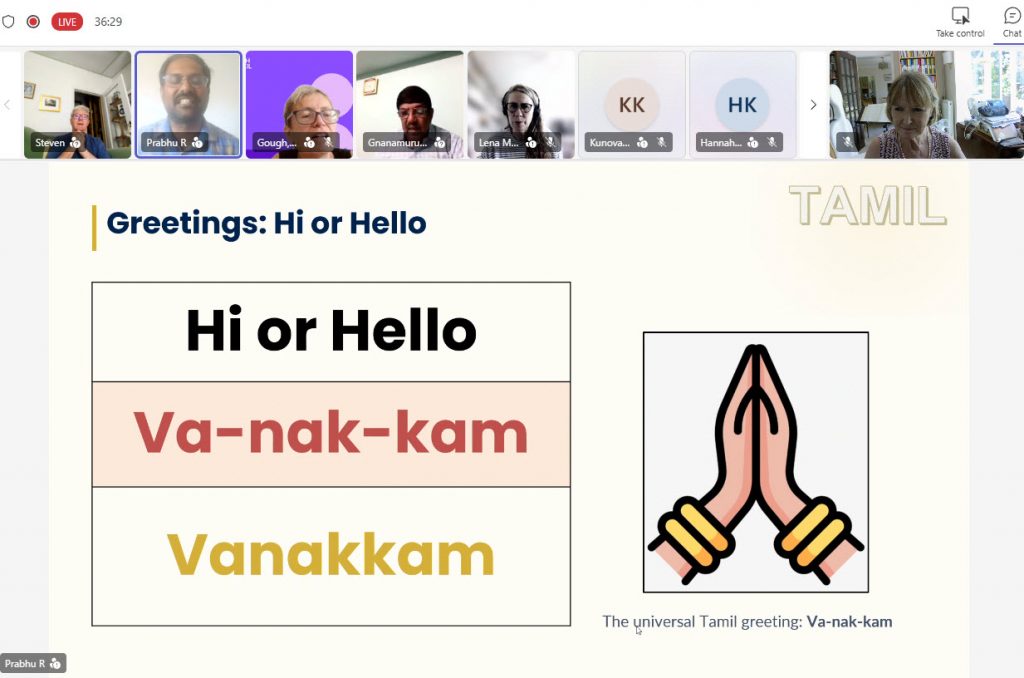
We started with greetings:
Vanakkam
Va – nak – kam
…accompanied by the traditional polite gesture. Each new step linked neatly to the last, building confidence and rhythm:
- Good morning
- Good evening
Very early on, everyone was invited to try speaking to each other – a simple but essential step in my view to helping to remember language through interaction – not just repetition.
Smiles, connection, and the joy of being heard
One of the most heart‑warming parts of the session was seeing the genuine smiles on the faces of Tamil speakers in the room as they heard us attempt their language. It was a moment of connection that captured the spirit of LCoL: opening doors, breaking down barriers, and celebrating the languages that make London vibrant.
The lesson demonstrated beautifully how, with thoughtful sequencing, learners can communicate meaningfully even at a very early stage. By learning the structure of phrases like I like coffee / I don’t like coffee, we could quickly substitute names or English words to get a feel for Tamil’s rhythm. [I – coffee – like = Yennakku coffee pidi-kum]
A language with deep roots
The linguistic insights woven throughout the session were fascinating. Tamil is a classical language spoken by around 70 million people worldwide, with a history stretching back over 2,000 years.
A great question from a participant led to a consideration about how the script has evolved depending on the medium — from stone being chipped, to palm leaves being written on, to digital code. A feature of Tamil is that the script Is not ‘fixed’ – it has moved with the times.
A slide on recommended Tamil foods added a delightful cultural and colourful touch.
Review, listening, and natural speech
A short review activity helped us match phonetically written Tamil to English translations, and Mr Gnanmurugan made sure that we were also tested on our listening comprehension when he said a phrase and we selected the translation from a multichoice. It was so satisfying to have proof of palpable progress in 40 minutes!
At Vicky’s request, our presenters also spoke naturally so we could hear the intonation and musicality of Tamil. Even without understanding every word, the shape and flow of a language can become recognisable – a reminder that listening is often the first step in language learning.
More than a lesson: a community invitation
What I took away from this session went far beyond vocabulary. I felt deep admiration for a community that not only preserves its linguistic heritage but actively invites others to appreciate its beauty. This is pride in the very best sense – generous, open, and welcoming.
The Tamil community is particularly vibrant in East Ham, Wembley, and Harrow, and this session felt like an invitation to explore further.
Looking ahead: more opportunities to discover languages
This Tamil Taster is just the beginning of LCoL’s commitment to offering opportunities to discover the languages spoken across London.
We often talk about the importance of mainstream teachers recognising that pupils bring a background of heritage languages spoken and used in their family. What better way to take a practical step than through sessions like this — where teachers can immerse themselves, try things out, and experience the joy of learning directly from community experts.
We are already planning more tasters, including sessions at times that work for teachers. We’re also exploring the idea of recorded introductions created by community groups to host on our YouTube platform.
Join us
Please come along and join in.
Be part of this celebration of London’s linguistic richness.
There is so much more to discover.
Nandri!